

R1 600,00
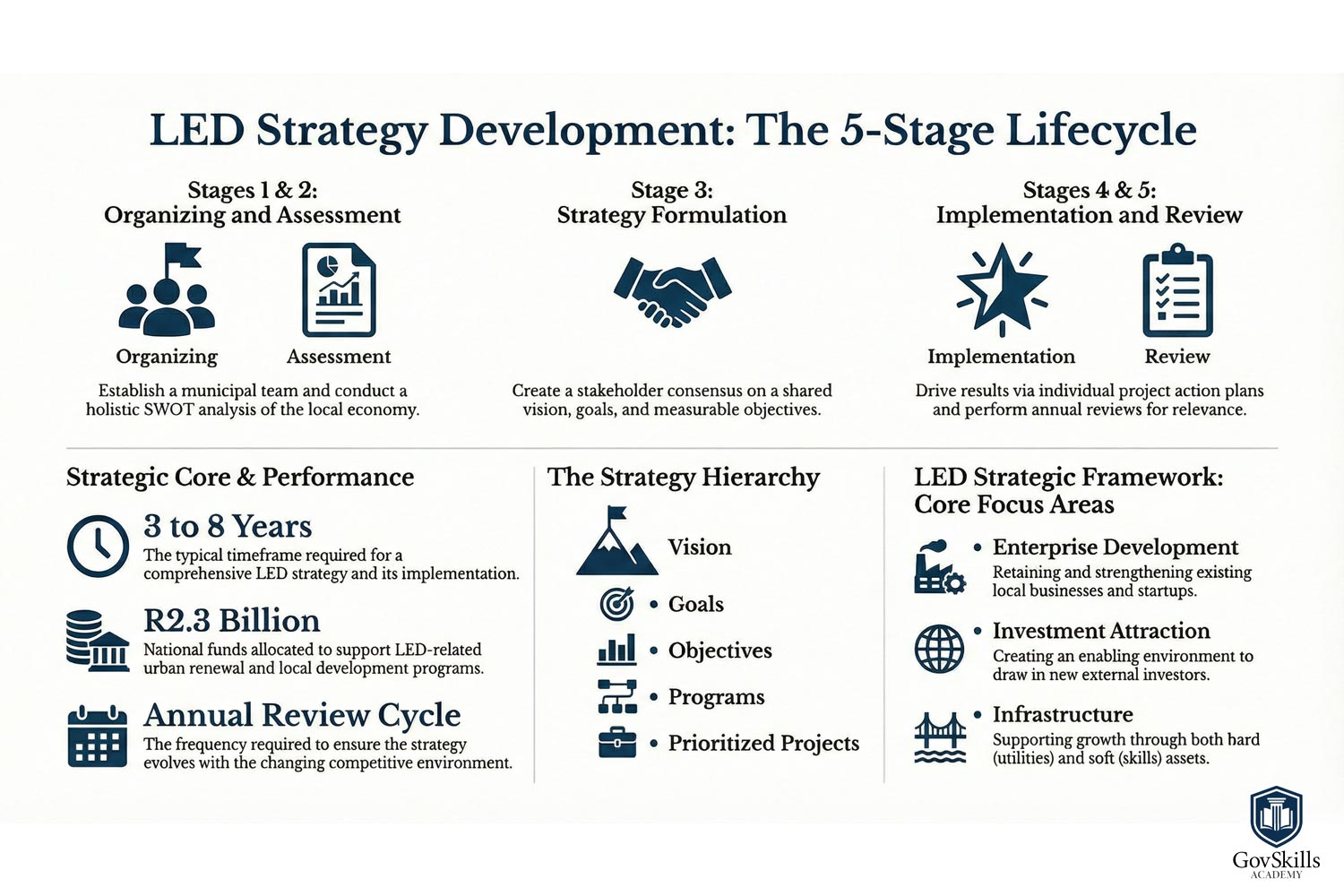
The National Framework for Local Economic Development (LED) in South Africa provides the strategic foundation for building robust, inclusive, and competitive local economies. The framework shifts the focus of LED from isolated, ad-hoc poverty-alleviation projects to a more strategic, systemic approach driven by two primary policy thrusts: Public Sector Leadership and Governance, and Sustainable Community Investment Programmes.
These overarching policy directions translate into four key, interrelated LED strategies (often referred to as the four thrusts) that guide municipal action:
1. Improving Good Governance, Service Delivery, and Market Confidence This thrust emphasises that a municipality’s primary role in LED is to create an enabling environment for business rather than trying to create jobs directly. It focuses on getting the municipal basics right: providing reliable infrastructure, ensuring efficient basic service delivery, managing progressive property tax systems, and reducing bureaucratic “red tape”. By demonstrating sound administration, transparent processes, and reliable services, municipalities build public trust and inspire confidence among potential investors.
2. Spatial Development Analysis and Competitive Advantage Because different spatial areas require tailored institutional responses, this strategy requires municipalities to thoroughly assess their local economies to identify and exploit their unique comparative advantages across the 52 municipal regions. It involves aligning local spatial development frameworks with national policies, targeting priority growth sectors, and encouraging the formation of economic clusters to maximise industry linkages and local value addition.
3. Intensifying Enterprise Support and Business Infrastructure Since enterprises are the primary engines of job creation and economic growth, this thrust focuses on making it easier to start, operate, and grow a business in the local area. Interventions include establishing Business Development Services (BDS), improving access to finance, and building essential “hard” and “soft” economic infrastructure. By supporting existing businesses, attracting new investors, and nurturing emerging entrepreneurs, municipalities can foster sustained local competitiveness.
4. Sustainable Developmental Community Investment Programming (SDCIP) To ensure LED is socially inclusive and bridges the gap between South Africa’s first and second economies, this thrust specifically targets marginalised communities. It uses empowering instruments to build community commercial competence, encouraging active participation in sectors like crafts, fresh produce, waste collection, and street trading. A key focus is making public procurement systems more accessible to historically disadvantaged individuals and maximising the local income multiplier effect of government spending.
Together, these four thrusts provide a comprehensive roadmap for municipalities to pursue holistic, partnership-driven economic growth.