

R1 100,00
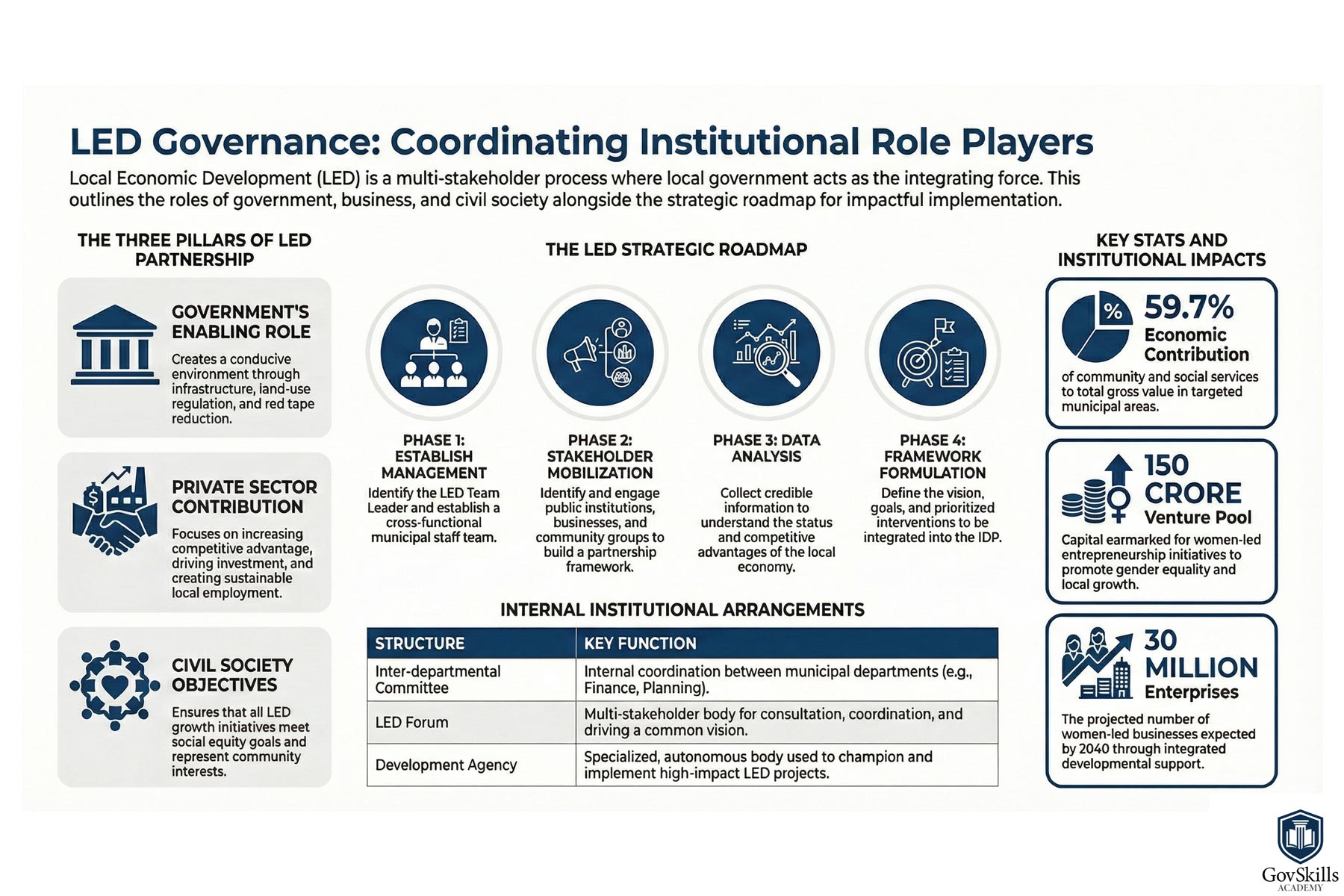
The course on “Institutional Arrangements and Network Instruments for LED Implementation” emphasises that Local Economic Development (LED) cannot be achieved by government alone,. It requires a coordinated, robust partnership between the public sector, private enterprise, and civil society.
Here is a summary of the key institutional role-players and structures:
National and Provincial Government The national government provides the overarching policy and support framework. Specifically, the Department of Provincial and Local Government (dplg) drives the National LED Strategy through its Support Unit. They handle critical grants, oversee capacity-building initiatives like ‘Project Consolidate’, and manage the ‘Knowledge for LED’ programme to disseminate best practices. Provincial and district authorities act as vital links to align local initiatives with broader regional growth strategies.
Local Government’s Role At the local level, a municipality acts as a facilitator rather than a direct job creator, focusing on providing an enabling environment for business growth,. The core internal driver for this is the LED Unit (typically comprising an LED Manager, Coordinator, and Officers),. This unit is responsible for coordinating LED programmes, managing resources, and ensuring that LED strategies are deeply integrated into the municipality’s Integrated Development Plan (IDP).
Key Support Structures and Arrangements Because LED is a cross-cutting issue affecting multiple sectors, the course highlights three critical institutional structures needed to manage implementation:
The Private Sector and Civil Society Finally, the course outlines the indispensable role of non-governmental actors. Private enterprises drive investment and industry linkages, whilst civil society and community-based organisations ensure that LED strategies remain equitable, inclusive, and grounded in local needs.