

R1 200,00
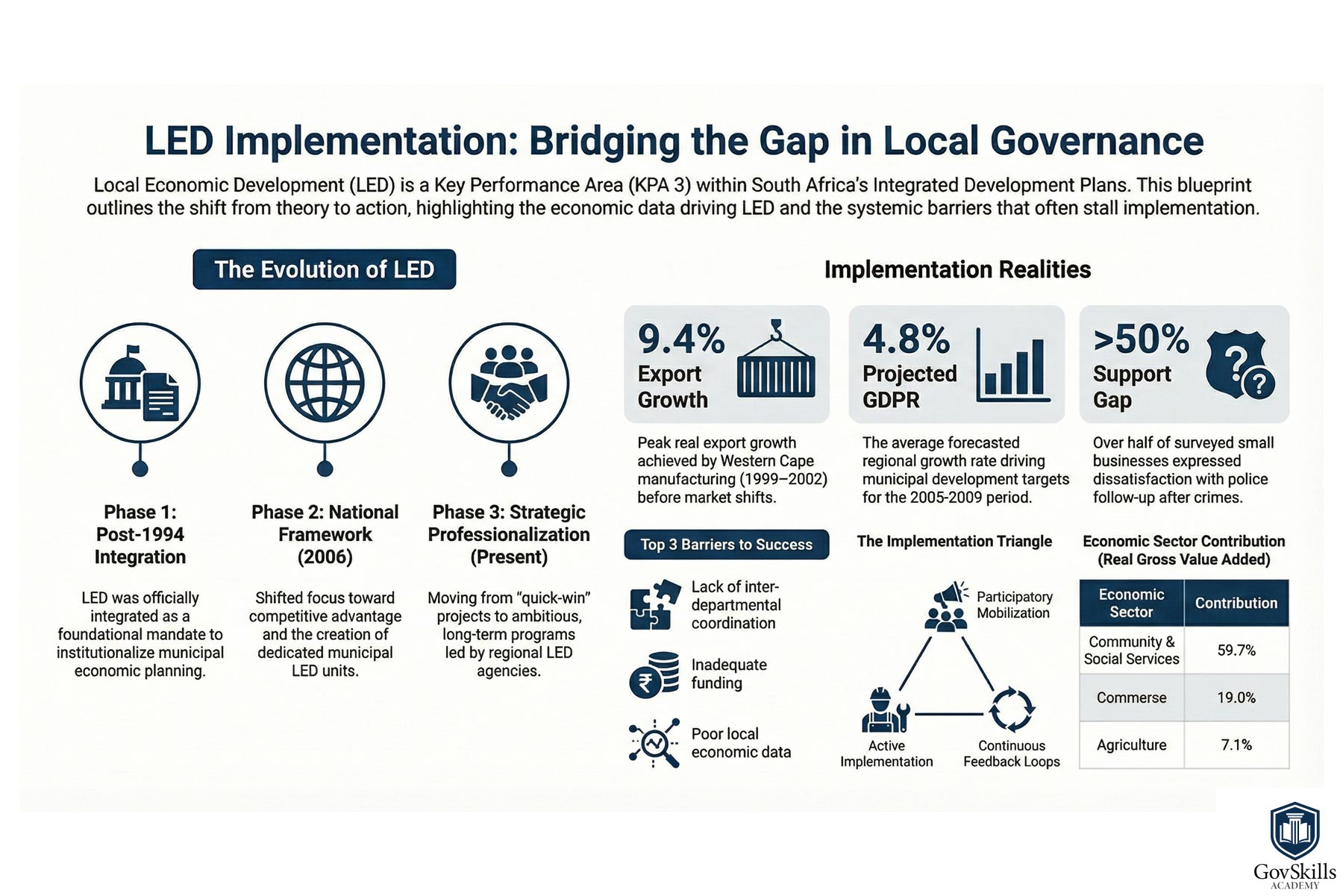
Implementing Local Economic Development (LED) in South Africa faces numerous systemic and practical challenges. Although the overarching policy framework is robust, translating strategy into action frequently stalls due to conceptual confusion, severe capacity constraints, and a lack of coordination.
Conceptual and Coordination Roadblocks A significant obstacle is the lack of understanding or agreement on what LED actually means within local government. This conceptual confusion is often exacerbated by conflicting views on whether LED should focus strictly on pro-poor poverty alleviation or pro-market economic growth. Furthermore, LED implementation continuously suffers from a lack of coordination within municipalities, and between provincial structures, the private sector, and civil society. This lack of genuine partnership marginalises key local actors and leads to duplicated or conflicting efforts.
Capacity and Institutional Hurdles Decentralisation has placed massive LED responsibilities on local municipalities that often lack the necessary skills, resources, and capacity to execute them effectively. Consequently, LED is frequently viewed as an “unfunded mandate” and is marginalised from the municipality’s mainstream basic service delivery. Many local governments also suffer from a poor understanding of their own local economies. Without properly utilising empirical data and economic assessment tools, they struggle to identify genuine comparative advantages. Furthermore, bureaucratic “red tape”—complex business regulations, cumbersome permit procedures, and outdated land management practices—inhibits local businesses from responding to new market opportunities.
Funding and Project Sustainability Inadequate funding and a heavy reliance on short-term public investment programmes are major barriers to successful LED. Historically, grant-driven initiatives tended to support small, uncompetitive, and financially unviable community projects. These projects often suffered from severe grant dependence and over-subsidisation, failing to become commercially sustainable or attract meaningful private sector involvement.
The “Talk is Cheap” Phenomenon A major critique of LED implementation is that strategic planning often results in expensive consultant reports rather than actionable, budgeted operational plans. LED strategies frequently lack clear targets, fail to assign responsibilities, and underestimate the timeframes and costs required to achieve their objectives. Implementation is further hindered by a widespread failure to connect approved LED plans to actual municipal budgets or integrate them effectively into the Integrated Development Plan (IDP). Additionally, there is often little to no reference to developing indicators, monitoring, or evaluation, making it impossible to measure success or hold role-players accountable.
To overcome these barriers, local governments must shift from attempting to create jobs directly to acting as facilitators that foster an enabling business environment. This requires building dedicated LED institutions, retaining skilled staff, cutting red tape, and forging genuine public-private partnerships to ensure long-term, sustainable growth.