
R1 400,00
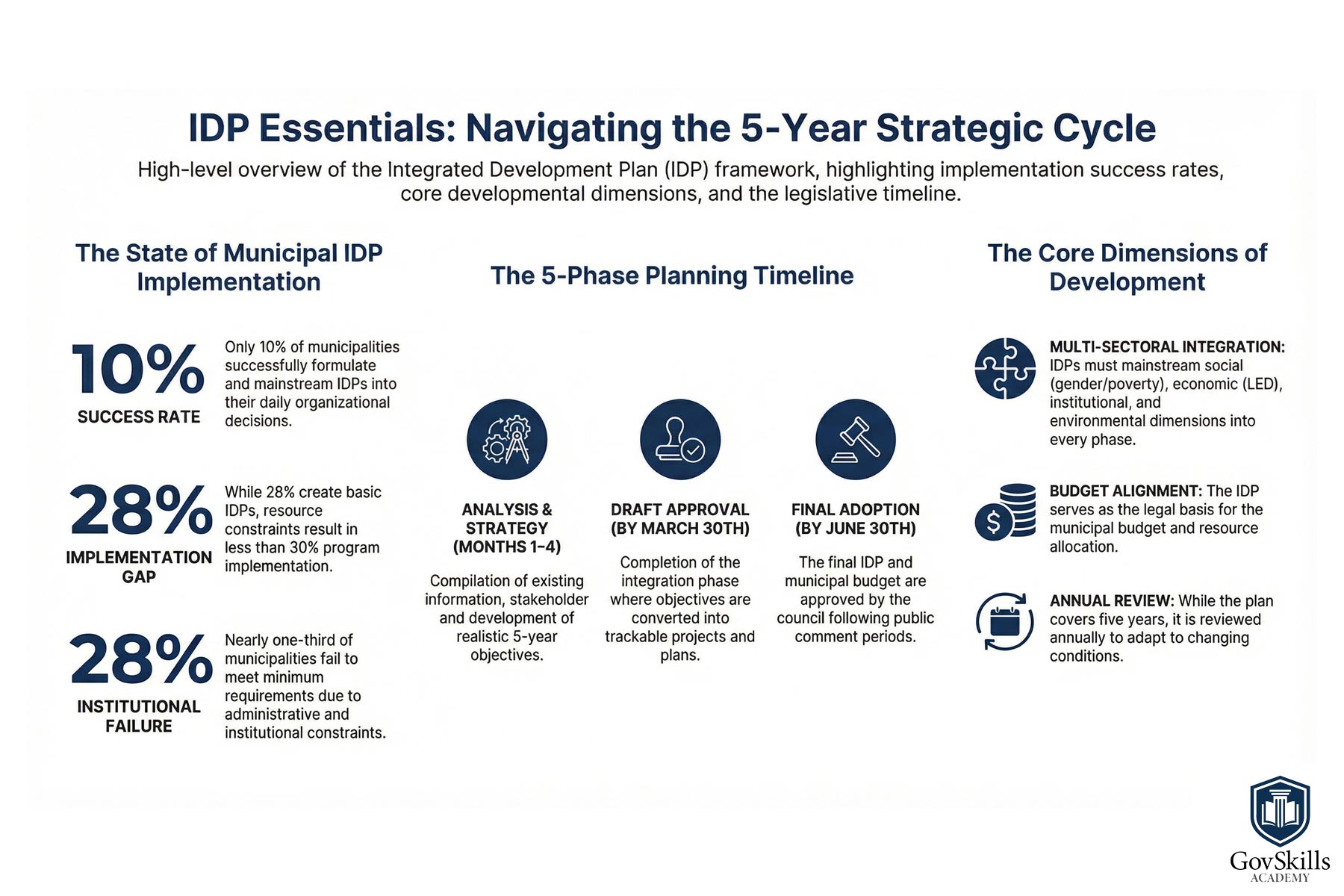
The Integrated Development Plan (IDP) process is typically structured around five distinct phases executed over nine months. It transitions a municipality from identifying community problems to implementing funded, strategic solutions.
Phase 1: Analysis This phase establishes the current reality of the municipal area. It involves compiling demographic, spatial, and institutional data to assess the existing level of development and identify service gaps. Through extensive community and stakeholder consultation, municipalities identify and agree upon local priority issues, ensuring planning is driven by actual needs rather than internal assumptions.
Phase 2: Strategies Moving from problems to solutions, municipalities decide on the most appropriate ways to resolve their priority issues. Rather than applying standard preconceived solutions, this phase provides strategic choices. Planners collaboratively formulate a shared, long-term municipal vision and set specific, measurable working objectives. This phase also establishes localised strategic guidelines covering cross-cutting dimensions like spatial planning, poverty alleviation, gender equity, and Local Economic Development (LED).
Phase 3: Projects Often referred to as the “nuts and bolts” phase, this is where strategies are translated into concrete, implementable project proposals. Municipalities form dedicated Project Task Teams—often including technical experts and affected community members—to design these interventions. Teams define target groups, project locations, major activities, and preliminary budget allocations. Crucially, they establish performance indicators to measure the project’s future impact.
Phase 4: Integration This phase ensures internal strategic consistency, verifying that all proposed projects align with the municipality’s overarching objectives, financial resource frames, and legal requirements. Project proposals are harmonised into a consolidated operational strategy to prevent duplicated efforts. Key outputs include a 5-year financial plan, a 5-year capital investment programme, a Spatial Development Framework (SDF), disaster management plans, and integrated sector programmes (such as water, transport, and waste management).
Phase 5: Approval The final phase focuses on securing broad-based support and legal compliance. The draft IDP is released for a 3-week public comment period. It also undergoes horizontal coordination at the district level to avoid conflicting development between neighbouring municipalities, alongside alignment checks with provincial and national government priorities. After incorporating relevant feedback, the final IDP is officially adopted by the municipal council.